Race Day Report
The Cleetus McFarland Effect: How One Creator Is Rewiring Motorsports Culture
By Lindy Williams
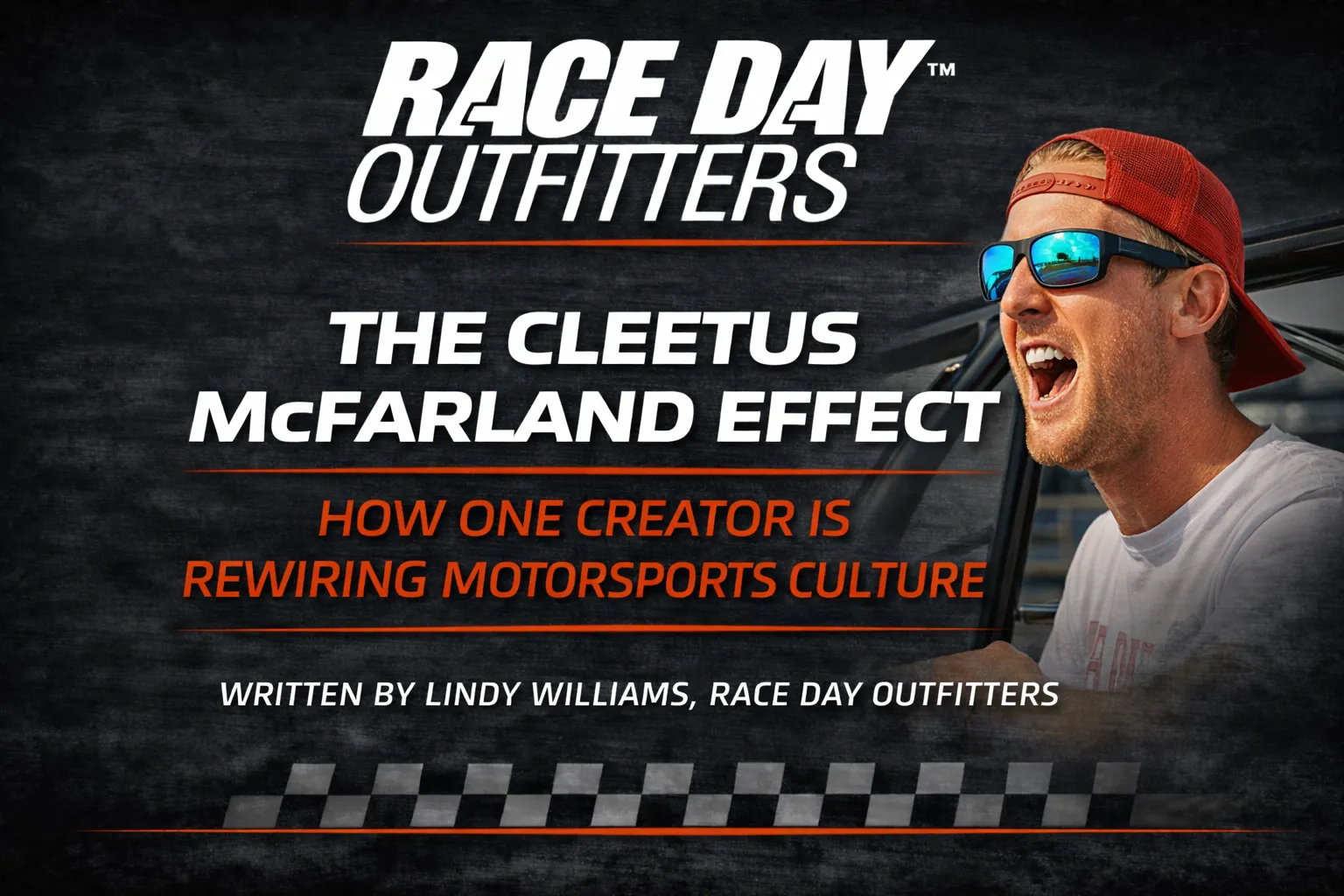
Explore the Cleetus McFarland effect and how one creator is reshaping motorsports culture through authenticity, entertainment, community, and fan-driven brand power.
Written by Lindy Williams, Race Day Outfitters
There are a lot of people in motorsports with fans. There are fewer with true followings. And then there is Cleetus McFarland.
What Cleetus has built is bigger than a YouTube channel, bigger than a merch brand, and bigger than a handful of viral racing events. He has created a full-on motorsports ecosystem that feels part grassroots racing, part live entertainment, part internet culture, and part American throwback energy. That is what I call the Cleetus McFarland effect.
It is the ability to take car culture, remove the stiffness, turn the fun all the way up, and make huge numbers of people care again.
For years, motorsports has fought a quiet battle against over-polished presentation. Big racing still has massive value, but sometimes the experience can feel distant from the average fan. The cars are expensive, the teams are corporate, the access is limited, and the personalities can get filtered down until they all sound the same. Cleetus went the other direction. He leaned into personality, absurdity, risk, fun, and the feeling that anything can happen.
That matters.
Because fans are not always just looking for perfect racing. A lot of the time, they are looking for connection. They want to feel like they know the people behind the wheel. They want unpredictability. They want inside jokes, recurring characters, rough edges, and a reason to care beyond a stats sheet. Cleetus understood that before a lot of traditional racing did, and he built his world around it.
The result is something pretty rare in modern motorsports: a brand that feels alive.
Part of the Cleetus McFarland effect is that he made motorsports feel accessible without making it feel small. That is a hard line to walk. He can put on something chaotic and hilarious, but it still carries enough production, enough stakes, and enough spectacle to feel real. He has shown that a creator-driven event can feel major without needing to copy the corporate sports model exactly. That is a lesson a lot of people in racing, media, and merchandising should be paying attention to.
Another big part of his impact is that he understands community better than most promoters. His audience does not just watch. They participate. They buy in. They show up. They wear the gear. They know the language. They understand the references. They follow the builds, the setbacks, the wins, and the cast of characters around the brand. When people support Cleetus, they are not just buying a ticket to a show. They are buying into a world.
That is where the real power is.
In today’s landscape, attention is hard to get and even harder to keep. Cleetus has built a model where the audience is emotionally invested long before race day arrives. By the time the event happens, fans already feel like part of the story. That is not accidental. That is excellent brand building.
And from a Race Day Outfitters perspective, it is impossible not to notice what that does for merchandise.
The Cleetus McFarland effect is not just about views and ticket sales. It is also about identity. His fans want to wear the brand because the brand means something to them. It signals humor, horsepower, independence, irreverence, and a love of doing things the loud way. Great merchandise always works best when it represents belonging, and Cleetus has created one of the strongest belonging-based brands in modern motorsports culture.
That is a huge deal.
A lot of merch fails because it is treated like an afterthought. A logo gets slapped on a shirt and people hope the audience will buy it because they vaguely like the event. That is not how lasting merch works. Lasting merch comes from emotional connection. It comes from memorable moments, recognizable phrases, bold visuals, and a fan base that feels ownership over the experience. Cleetus has all of that in spades.
He has also helped blur the line between motorsports fan, content fan, and lifestyle fan. Years ago, people often stayed in their lanes. You were a drag racing fan, a circle track fan, a NASCAR fan, or just a car guy. What Cleetus has done is create a magnet that pulls in all kinds of people at once. Some come for burnouts. Some come for racing. Some come for the personalities. Some come because it feels like the last place on earth where people are still allowed to have loud, stupid, mechanical fun without apologizing for it.
That broad appeal is part of why the effect keeps growing.
It also speaks to something bigger happening in motorsports right now. Fans are rewarding authenticity. They are rewarding people and brands that feel direct, funny, imperfect, and real. They are gravitating toward energy over polish. Toward personality over scripts. Toward experience over presentation. Cleetus McFarland did not invent all of that, but he has become one of the clearest examples of it working at scale.
And maybe that is the biggest lesson.
The Cleetus McFarland effect proves that motorsports does not need to be watered down to grow. It needs to be made more human. More entertaining. More connected. More culturally aware. People still love engines, speed, danger, noise, and competition. But they also want storylines they can follow and personalities they can latch onto. They want events that feel like happenings, not just schedules. They want to laugh. They want to share clips. They want to bring friends who may not know all the rules but still leave saying, “That was awesome.”
That is a real shift.
It means the future of motorsports promotion is probably not just in sanctioning bodies, teams, and TV deals. Some of it is going to come from creator energy, direct fan connection, and brands that know how to turn a race into an event and an event into a movement. Cleetus has shown that the path does not have to look traditional to be wildly effective.
Will every creator be able to do what he has done? No chance. What he has built takes instinct, consistency, guts, business sense, and a strong feel for audience psychology. But his success does offer a blueprint. It says that there is still huge upside in motorsports for the people willing to build culture instead of just content.
That is the real effect.
Cleetus McFarland has helped remind a lot of people that racing can still be rowdy, funny, emotional, unpredictable, and communal. He has shown that a motorsports brand can feel grassroots and massive at the same time. He has proven that fans will support what feels genuine. And he has pushed the entire industry, whether it admits it or not, to think harder about what today’s audience actually responds to.
That is not just influence. That is disruption.
And in a time when motorsports is fighting for attention from every direction, disruption might be exactly what keeps it loud.